
Reverse Circulation (RC) drilling has quietly become one of the most in-demand exploration and production drilling methods across mining, groundwater, and geotechnical sectors. As global demand for copper, lithium, and battery metals keeps rising — and as water scarcity drives deeper well drilling — contractors and exploration companies are accelerating their shift from conventional rotary and even some diamond coring programs toward RC rig fleets.
This article breaks down why RC drilling is gaining share, where the technology is heading in 2026, and how buyers should evaluate rig specifications before investing.
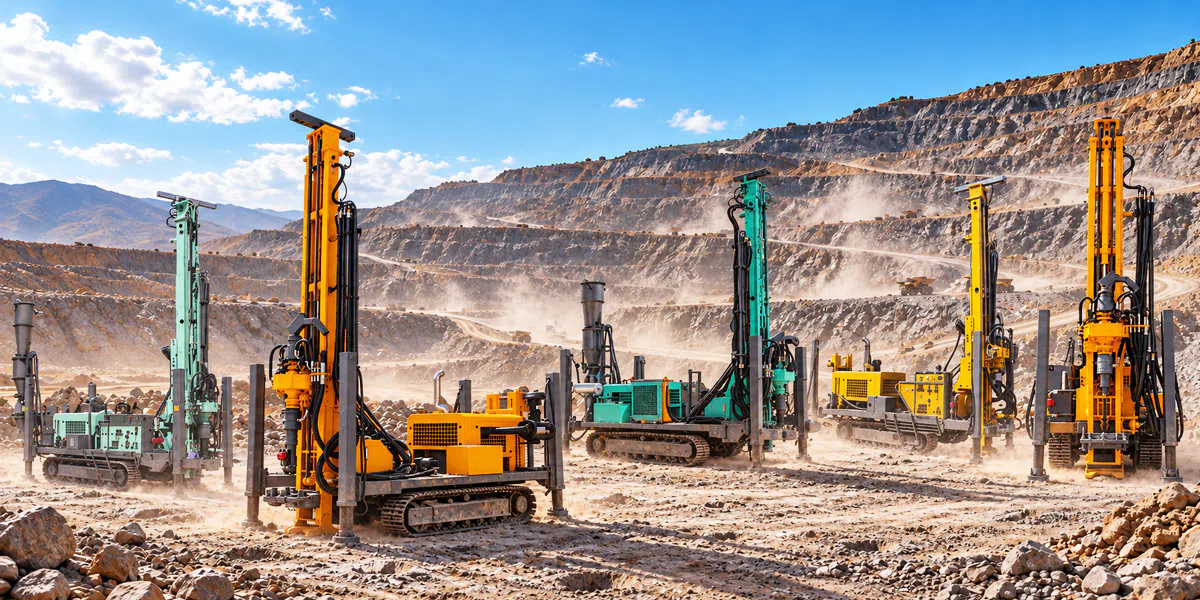
1. What Is Reverse Circulation Drilling — and Why Does It Matter?
Reverse Circulation drilling is a drilling method where compressed air is forced down through the inner drill rods, flushing cuttings up through the annulus between the inner and outer drill rods — directly into a cyclone and sample collection system at surface.
Unlike conventional rotary drilling, where cuttings are blown up the outside of the hole, RC delivers:
- Better sample integrity — cuttings are less contaminated and less likely to be mixed with material from higher up the hole, which is critical for mineral exploration where accurate grade control depends on reliable samples.
- Faster penetration — air-based flush eliminates the need for mud circulation in many formations, reducing trip times and simplifying site setup.
- Lower operational cost per meter — especially in hard rock, dry formations, and layered ground where mud systems are expensive to maintain.
- Dual-use capability — many modern RC rigs can be converted to down-the-hole (DTH) hammer drilling or even shallow coring, giving contractors more project flexibility.
---
2. The Market Driver: Why RC Rig Demand Is Accelerating
Several converging forces are pushing RC rig orders higher in 2025–2026:
2.1 The Energy Transition Is Feeding Exploration Drilling
Copper, lithium, nickel, and rare earth projects are breaking ground on every continent. RC drilling remains the fastest, most cost-effective method for "early-stage resource definition and grade control" — the stage where most exploration budgets are spent. Even projects that will eventually use diamond core drilling for resource estimation typically first define the target with RC, because RC can cover 3–5× the footage per day at a fraction of the cost.
2.2 Groundwater Development in Arid Regions
Middle Eastern, North African, Australian, and South Asian water authorities are drilling deeper and wider boreholes to meet municipal and agricultural demand. RC rigs, particularly those with high-pressure air compressors integrated on-board, are winning contracts because they can complete a 200–400 m water well in days, not weeks.
2.3 Infrastructure and Piling Booming
Post-pandemic infrastructure investment — bridges, high-speed rail, wind farm foundations, and solar pile driving — is creating demand for rigs that can switch between RC sampling and pile hole drilling. Multi-purpose rigs are replacing single-function machines.
2.4 The China and Global Manufacturing Response
Chinese drill rig manufacturers, including "Yugong Group", have dramatically closed the quality gap with European and Australian OEMs over the past five years. Buyers in Africa, Southeast Asia, South America, and the Middle East now routinely source RC rigs from China at "30–50% lower acquisition cost" with comparable component sourcing (hydraulics, compressors, drill strings) and improved after-sales support networks.
---
3. Technology Trends Reshaping RC Rigs in 2026
3.1 On-Board High-Pressure Compressors
The trend is away from trailer-mounted, separate compressor units toward "integrated, containerized compressors mounted directly on the rig carrier". Benefits: faster mobilization on rough terrain, fewer support vehicles on site, and lower fuel burn from a single power pack.
3.2 Automated Rod Handling and Digital Depth Tracking
Manual rod loading is being replaced by mechanical rod handlers and automatic breakout systems — reducing crew size from 4 to 2–3 people, improving safety, and cutting cycle time per rod. Digital depth counters connected to GPS and cloud platforms now let mine geologists view sample intervals in real time.
3.3 Deeper and Heavier-Duty Capacities
RC rigs that could drill 300 m ten years ago are now routinely rated for "500–800 m depth", with pullback forces exceeding 15–20 tonnes. This opens up deeper exploration and deeper water wells that previously required diamond coring rigs.
3.4 Dual-Purpose RC / Core Rigs
Hybrid rigs that switch between RC hammer drilling and wireline coring in the same hole are gaining tract


